

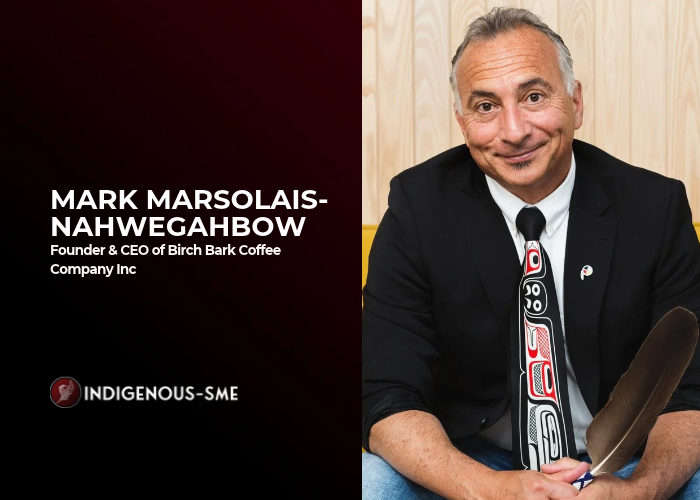
In an exclusive interview with Indigenous-SME Business Magazine, Mark Marsolais-Nahwegahbow, Founder & CEO of Birch Bark Coffee Company Inc., shares his journey of building a First Nations-owned Canadian coffee company rooted in culture, quality and community impact. An Ojibwe entrepreneur and Citizen of Whitefish River First Nation, Mark brings nearly four decades of experience in justice, education and Indigenous advocacy to his work in business.
Interview By Darian Kovacs
From a vision to create meaningful change through everyday coffee, Mark has grown Birch Bark Coffee Company into a Certified Indigenous, Fairtrade and Canada Organic business, while establishing the Birch Bark Foundation Fund to support Indigenous communities and organizations. His story demonstrates how Indigenous entrepreneurship can combine national business growth with cultural identity, purpose and lasting community impact.
Mark Marsolais-Nahwegahbow is an Ojibwe entrepreneur, Band Member and Citizen of Whitefish River First Nation on Manitoulin Island. He is the founder and CEO of Birch Bark Coffee Company, a First Nations-owned Canadian coffee company built on the belief that business can be successful while creating meaningful change. Before becoming an entrepreneur, Mark spent close to four decades working in justice, education and Indigenous advocacy, including work as a Gladue writer, consultant and college instructor.Through Birch Bark Coffee Company, Mark has built relationships with major institutions, corporations, retailers, colleges and universities across Canada. The company is a Certified Indigenous Business, Fairtrade certified and Canada Organic certified. Mark also established the Birch Bark Foundation Fund through the Ottawa Community Foundation to create a permanent way for the company’s success to support Indigenous communities and organizations.
What inspired you to launch Birch Bark Coffee Company?
Birch Bark Coffee Company started with something much bigger than coffee. I was deeply troubled by the fact that First Nations communities in Canada were still living without reliable access to clean drinking water. I kept asking myself what I could personally do about it. I did not come from the coffee industry. I came from close to four decades of working in justice, education and with Indigenous people and communities. But I understood that business could become a vehicle for change. Coffee made sense because it is something millions of Canadians drink every day. I saw an opportunity to build a First Nations-owned national coffee company that could compete based on quality while also creating a way to give back. I started Birch Bark Coffee Company with very little, but with a clear purpose: sell great coffee, build a strong Indigenous business and use that success to help create lasting positive change.
That purpose still guides us today.

How does Indigenous culture and community shape your business?
Indigenous culture is not something we added to Birch Bark Coffee Company as a marketing strategy. It is part of who we are. I am Ojibwe and a citizen of Whitefish River First Nation. The way I was raised, the teachings I have received and my experiences working with Indigenous communities have shaped how I look at business. For me, relationships matter. Respect matters. Accountability matters. And when you are successful, you have a responsibility to think beyond yourself.
That is reflected in our products, our artwork, our storytelling and the organizations and communities we work with. But it also affects how I make decisions behind the scenes. I want young Indigenous people to see companies like Birch Bark Coffee and understand that we can build businesses that compete nationally without giving up who we are. We do not have to choose between culture and business success.
We can bring both together and create something uniquely our own.
What does meaningful impact mean to you as a business owner?
Meaningful impact must outlast the sale that created it. As the company grew, I realized the commitments I had made needed a permanent structure behind them, not just good intentions. That led to the creation of the Birch Bark Foundation Fund through the Ottawa Community Foundation. It provides a transparent and long-term way for our success to support Indigenous-serving organizations and initiatives, and it supports seven of them, each one paired with one of the Seven Grandfather Teachings. Impact also means creating visibility. Every time Birch Bark Coffee is served in a workplace, university, institution, store or home, people are seeing a First Nations-owned company competing in the mainstream Canadian economy. To me, success is not simply how much coffee we sell.
It is what we are able to build because we sold it.
What challenges have helped shape your entrepreneurial journey?
Almost every stage of building Birch Bark Coffee Company involved learning something the hard way. I did not start with investors, a large team or decades of experience in the coffee industry. While building the company, I had to learn purchasing, roasting, packaging, logistics, pricing, distribution, retail and national accounts.There have been supplier changes, rising coffee costs, distribution challenges and relationships that did not work out as I expected. Those experiences taught me one of the most important lessons in business: never become so dependent on one supplier, customer or relationship that you lose control of your company. They also taught me to trust my instincts. As Indigenous entrepreneurs, we sometimes walk into rooms where nobody expects us to own the company or be the decision-maker. You learn quickly that you have to understand your value and be prepared to stand your ground.
Challenges have made Birch Bark Coffee stronger because they forced me to keep adapting.
What advice would you give to Indigenous entrepreneurs starting a business today?
You can spend years waiting for the perfect business plan, enough money, the right partner or someone to tell you that your idea is good enough. At some point, you have to move. Know why you are starting the business and protect that reason. Learn your numbers. Understand your costs. Ask questions when you do not know something and never be embarrassed about learning. Most importantly, do not underestimate your value as an Indigenous entrepreneur. Being Indigenous should never mean that your company is expected to be smaller, cheaper or less competitive. Build something that can stand beside any other company in your industry. Surround yourself with people who genuinely want you to succeed, but maintain control over your business and your decisions.There will be mistakes. I have made plenty. The important thing is learning from them quickly and continuing forward. And remember that success does not require you to leave your identity behind.
Bring it with you.
What is next for Birch Bark Coffee Company, and how can readers support the work?
We are focused on growth that we can sustain. That means expanding into more retail, campus and workplace coffee programs across the country, and continuing to build the kind of national presence that lets the Foundation Fund do more every year.
The most direct way to support this work is to choose our coffee. Anyone can order through our website, and organizations can bring Birch Bark into their offices, campuses and events through our wholesale program. For companies thinking about economic reconciliation, this is one of the most practical places to begin. Procurement is a decision you already make every day. Choosing to buy from Indigenous-owned businesses turns a routine purchase into something that strengthens Indigenous families and communities.
Every bag does something. That has been the idea from the first day.
Disclaimer : Indigenous-SME Business Magazine is committed to providing insightful interviews that highlight the successes and challenges faced by small and medium-sized businesses. The views expressed in this interview are those of the guest and may not reflect the opinions of the magazine or its affiliates.


